
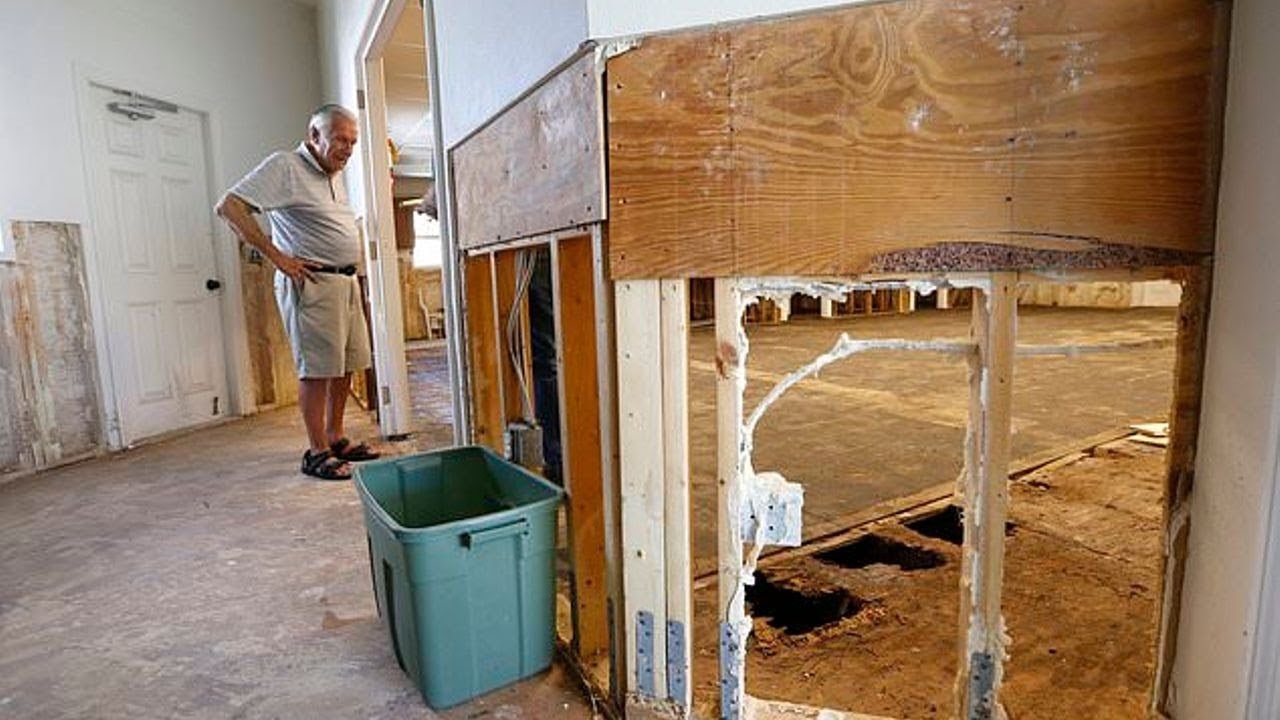
The waterline mark on the outside wall of the Rod and Gun Club is at roughly chest height, depending on how tall you are, and it requires no caption once you know what you are looking at. September 2017. Hurricane Irma drove the Gulf of Mexico into Everglades City with a surge that filled the ground floors of most of the buildings in town and left a brown tidemark on everything that survived. I noticed it on my second visit here, about eight months after the storm, standing in the parking lot while a great blue heron stood on the seawall behind me and waited for something to surface in the canal. The town smelled like low tide and drying wood and marine epoxy. The Rod and Gun Club was not yet open. Neither were several other places. But people were working, visibly and without fanfare, and the quality of that work had a particular character to it that I kept thinking about afterward, the specific look of people who have decided to fix a thing because it is theirs, not because someone told them it was worth fixing.
That distinction matters here more than in most places.
Everglades City is at the end of a single road that leaves the Tamiami Trail and goes south until it has nowhere left to go. Population under five hundred, most years. Sitting at the exact point where the freshwater sheet of the Everglades meets the saltwater maze of the Ten Thousand Islands, where the ecology of two entirely different worlds converges in a tangle of mangrove and mullet and roseate spoonbill and stone crab. The town is not pretty in the way that small coastal towns in Florida are often described as pretty. The buildings are functional. The streets are mostly empty except during stone crab season and the Seafood Festival, when the population briefly multiplies to something closer to ten thousand and the town tolerates it with the manner of someone who has agreed to host a large family gathering and is quietly relieved when it ends.
What I did not expect, the first time I came here, was the silence. Not the silence of emptiness but the silence of a place that simply does not perform for visitors. There are no sandwich boards on the highway. There is no welcome center. The water is everywhere and the sky is enormous and the road ends and that is the whole of the announcement. You have arrived somewhere that was here long before you thought to come and will be here long after you have left and written your small version of it on the internet.
The version that has been written most often since Irma is the comeback story. Town destroyed, community rebuilds, stronger than before, the stubborn spirit of old Florida, and so on. It is not false, exactly. The rebuilding was real and the stubbornness is genuinely a quality of this place. But I want to be careful about what the comeback narrative does, because I have watched it travel from conversation to article to travel platform to social media caption and at each stage it becomes slightly more convenient, slightly more legible, slightly less like the actual town. The people who rebuilt Everglades City after Irma were not performing resilience. They were doing the hard physical work of removing waterlogged drywall and salvaging outboard motors and arguing with insurance adjusters, and they did it because this is where they live and because nobody else was coming to do it for them.
What surprised me, and what has stayed with me, was a conversation I had with a man who runs a fishing guide operation here, third or fourth generation, who told me that the months after Irma were, in one specific sense, the most peaceful the town had felt to him in years. The season tourists could not reach them. The phones had stopped. His family spent the evenings on the porch of their partially repaired house and watched the stars over the Ten Thousand Islands and he said there was a quality to those evenings that he knew, even at the time, was temporary and would not come back the same way once the road opened again. He said this without particular nostalgia. Just as a fact about the interval between one thing and the next.
The town is more visited now than it was before Irma. That is also a fact. The comeback story moved through the travel media ecosystem and Everglades City acquired a new layer of attention that I do not think it would have chosen for itself if the choice had been available. On a weekend in late January, the parking area near the waterfront is full and the lines at the seafood shacks run back past the coolers. People in kayaks from the outfitters near the ranger station cross the water in a long, brightly colored line. Airboats move through the channels with their particular authoritative noise. It is not ruined. But it is different, and the difference is cumulative and probably irreversible and most of the travel writing about it does not mention this.
What I believe about Everglades City, after returning to it across several years and seasons, is that its value lies precisely in what it withholds. It does not explain itself to you. It does not adjust its pace to your visit or smooth its edges for your comfort or position its light for your photograph. You can paddle into a mangrove tunnel here until the canopy closes overhead and the GPS on your phone stops being confident and the only way you know where you are is by the direction of the water moving underneath you, and that experience is available to anyone who wants to pay attention enough to have it.
The question that the town has not yet had to answer is what happens when paying attention becomes the product.

Donald Reeves writes about Everglades City the way the place deserves to be written about: without the brochure language, without the manufactured wonder, and without pretending that a town of 400 people sitting at the edge of a swamp is something it is not.
He has spent considerable time in Collier County’s oldest settlement, arriving during stone crab season when the waterfront smells of brine and work, and returning in the off-season when the tourists are gone and the town goes quiet in the particular way that only genuinely remote places can. He has paddled the mangrove tunnels of the Ten Thousand Islands, eaten at places with no hours posted on the door, and spoken at length with fishing guides who navigate these waters by memory rather than chart.
His writing on Everglades City FL covers everything from tidal fishing conditions and kayak trails to lodging, local history, and the complex past that most Florida travel content carefully avoids.
He writes to give readers the honest version.