
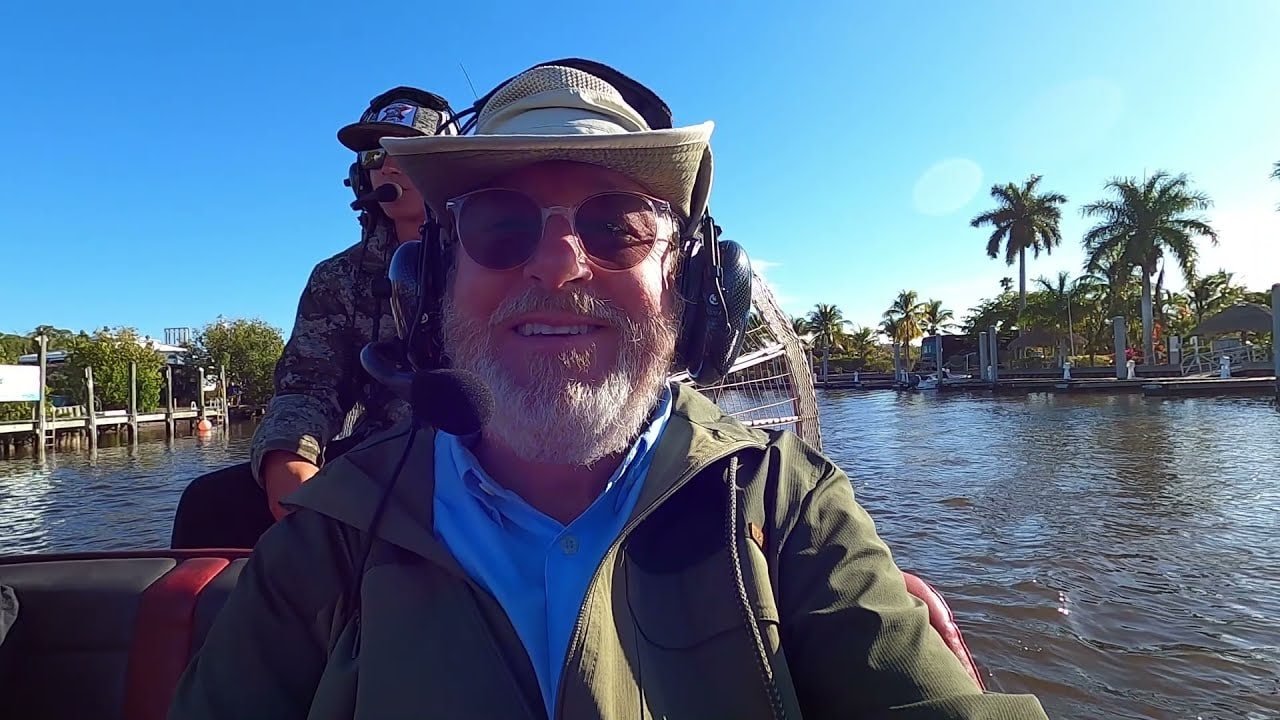
The airboat captain had a microphone and a script and he used both with the confidence of someone who had said the same sentences several hundred times and no longer heard them. We were sitting in stadium seats bolted to the deck of a flat-bottomed craft the size of a small living room, twelve of us in noise-canceling headsets, moving through a channel of sawgrass at a speed that guaranteed we would not see anything that did not want to be seen at that speed. When the engine dropped to idle near a spoil island and the captain gestured toward a log in the shallow water, everybody raised their phones. The alligator did not move. It had probably not moved in several hours. Whether it was there by arrangement or by habit I could not tell you with certainty, but the quality of its stillness had something programmatic about it.
This was a Friday afternoon in October. I had four more tours to get through before Sunday evening.
I should say what I was trying to understand before I say what I found. I had been to Everglades City enough times to know the place at something below its surface, in the way that regular return visits allow, and I wanted to understand what a first-time visitor was actually buying when they came here and chose from the grid of tour options that populate the booking platforms. Five tours in a weekend is not a rigorous methodology. It is simply enough to see the pattern.
The airboat operation was the most expensive single experience of the weekend and it was the least connected to anything I would call the actual Everglades. What it was, honestly, was a loud ride through a photogenic corridor with a narration designed to make passengers feel they had been somewhere. The captain knew his lines. The alligator was present. The sawgrass was genuine. But the whole thing had the texture of a performance reviewed so many times that the performers had forgotten what it was a performance of, and I drove back to town with the specific flatness that follows something that looked like an experience and was not quite one.
I will not list the other four in order because the hierarchy is not really the point. What I want to describe is the Saturday morning and what it cost and what it gave me.
A guide named Terrence, who has been working these waters since before I was old enough to drive to them, took me and one other person out in a flat-bottomed skiff at first light for a half-day trip through the northern edge of the Ten Thousand Islands. He charged a reasonable half-day rate and he did not have a microphone. What he had was the particular kind of knowledge that accretes over decades of paying attention to a specific place, the kind that includes not just where the fish are or where the birds nest but where the water moves differently in October than it does in February and why, and what the light on a certain stretch of mangrove means about what has recently passed through it. He spoke when he had something to say and was quiet when he did not. The quiet was not awkward. It was the appropriate response to being in a place that rewards attention.
At one point he cut the engine completely and we sat in the stillness for several minutes while a roseate spoonbill worked the shallows maybe thirty feet off the bow. I have seen photographs of roseate spoonbills. I have seen them on this same water before. The photographs do not capture the particular quality of the pink, which is not the pink of anything else I have seen in nature, and they do not capture the movement, which is methodical and somehow both mechanical and graceful in a way that makes you feel you are watching something that has been doing exactly this since long before anyone thought to photograph it. I found myself thinking that no version of this experience could be pre-arranged. It required the right water at the right hour with someone who knew which hour that was.
The thing that unsettled me was not the bad tours. I expected versions of what I found on the airboat, the commodification of proximity to wild things, and I was not wrong to expect it. What I did not expect was the Saturday afternoon, a mid-range group kayak tour with a guide from an outfitter near the ranger station, which was competently run and genuinely educational and left me feeling almost nothing. The guide was knowledgeable. The mangrove tunnel was real. The information was accurate. And yet the whole thing had a quality of careful packaging that kept the place at arm’s length, the way certain museum exhibits explain the thing so thoroughly that you forget to simply look at it. I stayed in the kayak afterward, after the others had returned their paddles, and sat in the mouth of the tunnel for a while in the low light and that fifteen minutes was worth more to me than the preceding two hours.
What I have come to believe, after that weekend and the ones before it, is that the Everglades resists the format that most visitors bring to it. It is not a backdrop. It is not a sequence of photogenic moments that a guide can reliably deliver. The thing that makes this particular corner of it worth returning to is precisely its indifference to the human desire for legible experience, and any tour that tries to resolve that indifference into something tidier is selling you a reduction.
The only honest way to spend money on this place is to find someone who loves it more than they love telling you about it.

Donald Reeves writes about Everglades City the way the place deserves to be written about: without the brochure language, without the manufactured wonder, and without pretending that a town of 400 people sitting at the edge of a swamp is something it is not.
He has spent considerable time in Collier County’s oldest settlement, arriving during stone crab season when the waterfront smells of brine and work, and returning in the off-season when the tourists are gone and the town goes quiet in the particular way that only genuinely remote places can. He has paddled the mangrove tunnels of the Ten Thousand Islands, eaten at places with no hours posted on the door, and spoken at length with fishing guides who navigate these waters by memory rather than chart.
His writing on Everglades City FL covers everything from tidal fishing conditions and kayak trails to lodging, local history, and the complex past that most Florida travel content carefully avoids.
He writes to give readers the honest version.