
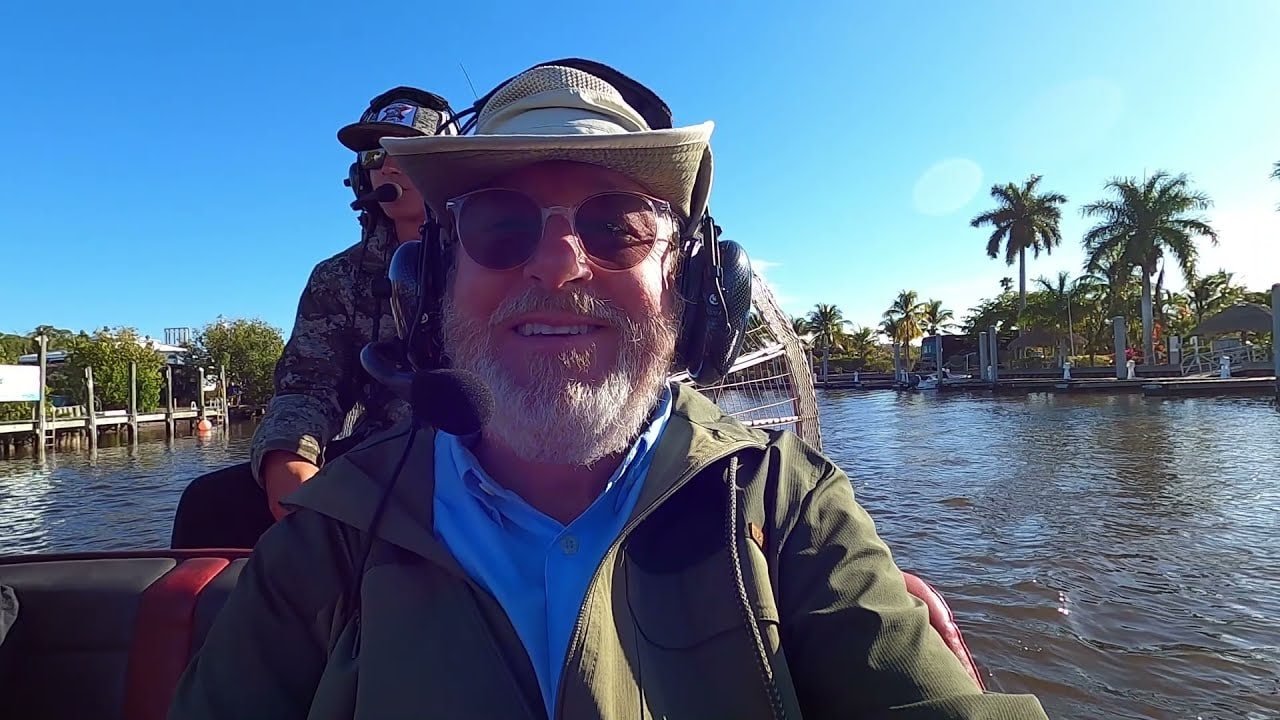
Terry cut the engine somewhere east of the buttonwood line and in the silence that came after, which is a silence that takes about three seconds to arrive because the airboat noise has a physical quality that lingers in the chest, we could hear the wind moving through the sawgrass and, further out, the sound of something large settling into shallow water that neither of us turned to look for right away.
I had been on the water with Terry for four hours by then. I use the first name because that is what everyone uses, and also because I never got the last name right on the first try and eventually stopped asking him to repeat it. He is, by his own account and by the account of everyone in Everglades City who would have a reason to know, the third person in his family to run airboats on these waters. His grandfather came down from the Glades fringe settlements in the 1940s. His father learned to read the water before he learned to read a page. Terry learned both, which is the detail that matters.
He is not sentimental about this.
What he is, and what took me most of the morning to understand correctly, is precise. There is a difference between a person who knows a landscape by having been told about it and a person who knows it by having moved through it in every season for most of their life, and the difference is not in the quantity of information but in the quality of attention. Terry does not tell you things about the Everglades the way a ranger tells you things about the Everglades, with categories and conservation status and the language of managed ecosystems. He tells you things the way a person tells you about a neighbourhood where they grew up, with reference to what used to be here and what changed when and why, and occasionally with a degree of irritation that I found entirely understandable given the circumstances.
The circumstances are the permit situation, which he will discuss if you bring it up and which he approaches with the specific weariness of someone who has had the same argument with the same category of people for two decades and has not won and has not quit. The federal agencies that manage large portions of the Everglades have, over those two decades, tightened the parameters within which airboat operators can work: where they can go, when, at what speeds, during which nesting cycles. Some of those restrictions, Terry will say directly, are correct. Others are based on research conducted by people who spent less time on these waters in a calendar year than he spends in a week, and who applied models from other ecosystems to this one in ways that do not quite fit the thing they are trying to describe.
He is not wrong about this. I have read enough of the relevant literature to know that the Everglades is genuinely difficult to study in the ways that produce the kind of data management agencies require, and that the gap between what the ecosystem actually does and what the models say it does is wide enough to accommodate a fair amount of policy that is well-intentioned and locally counterproductive.
The moment that changed how I was thinking about the morning came when Terry pointed toward a section of open water and told me that a particular wading bird species had been nesting there, intermittently, for as long as he could remember, and that the nesting pattern had shifted in the last eight years in a specific way that he described with the kind of granular detail that you would need a decade of uninterrupted observation to generate. He was not presenting this as an argument or a complaint. He was just describing something he had noticed over time, the way you describe the progression of a slow change in something you look at every day.
No one has asked him to write it down. No researcher has come to talk to him specifically about this. The knowledge lives in him and in the way he reads the water when he moves across it, and when he stops running airboats it will go with him, not into any archive or dataset or range management report.
I sat with that on the water for a while, with the sawgrass moving in the afternoon wind and the light going gold and flat over the open marsh the way it does out here when the day is thinking about ending, and I thought about what it means to have a form of knowledge that the institutions responsible for a place cannot absorb and do not, in any practical sense, seek out. The researchers come and collect their data and return to their institutions. The rangers rotate through postings, sometimes staying two years, sometimes three. The travel writers come for a long weekend and write about the experience of arriving.
Terry’s grandmother described what this water looked like before the management decisions of the 1960s rerouted the flow. His father watched what the fish populations did when the flow changed. Terry has forty years of his own observations layered on top of both.
That is not the kind of expertise that gets cited in management plans. It is, in many ways, the only kind that cannot be replicated by someone who does not have the time.

Donald Reeves writes about Everglades City the way the place deserves to be written about: without the brochure language, without the manufactured wonder, and without pretending that a town of 400 people sitting at the edge of a swamp is something it is not.
He has spent considerable time in Collier County’s oldest settlement, arriving during stone crab season when the waterfront smells of brine and work, and returning in the off-season when the tourists are gone and the town goes quiet in the particular way that only genuinely remote places can. He has paddled the mangrove tunnels of the Ten Thousand Islands, eaten at places with no hours posted on the door, and spoken at length with fishing guides who navigate these waters by memory rather than chart.
His writing on Everglades City FL covers everything from tidal fishing conditions and kayak trails to lodging, local history, and the complex past that most Florida travel content carefully avoids.
He writes to give readers the honest version.