
Touring America on Route 66 is a 2,448-mile road trip from Chicago, Illinois, to Santa Monica, California. The route crosses 8 states – Illinois, Missouri, Kansas, Oklahoma, Texas, New Mexico, Arizona, and California – and passes through 3 time zones. In 2026, Route 66 celebrates its 100th anniversary, known as the Centennial, making it the most significant year to drive the Mother Road since its decommissioning in 1985.
What Is Route 66?
Route 66 is a historic U.S. highway commissioned on November 11, 1926. It originally stretched 2,448 miles from Chicago to Los Angeles and served as the primary corridor for westward migration during the Dust Bowl era of the 1930s. Route 66 earned 2 nicknames: “The Main Street of America” and “The Mother Road,” coined by John Steinbeck in his 1939 novel, The Grapes of Wrath. For context, see our previous guide on Waimea Canyon Tour: 5 Tour Types, 4 Lookouts, 6 Hikes, and a Complete Visitor Guide.
Route 66 was officially decommissioned in 1985 after the Interstate Highway System replaced it section by section. It is now designated Historic Route 66. Travelers navigate state-marked alternate alignments and sections preserved through small towns bypassed by the interstates.
Where Does Route 66 Start and End?
Route 66 starts at Adams Street and Michigan Avenue in Chicago, Illinois, and ends at the Santa Monica Pier in Santa Monica, California. Most travelers drive west from Chicago to Santa Monica. The route can also be driven east from Santa Monica to Chicago.
The midpoint of Route 66 is in Adrian, Texas, located exactly 1,139 miles from both endpoints.
How Long Does It Take to Tour America on Route 66?
Driving the full length of Route 66 takes a minimum of 10 days. A more complete trip with stops, detours, and side routes takes 14 to 21 days. Experienced Route 66 travelers recommend planning for a maximum of 200 miles per day on sections with high attraction density, such as Illinois and Arizona.
Route 66 trip duration by travel style:
|
Travel Style |
Days |
Daily Miles |
|---|---|---|
|
Fast drive, minimal stops |
7-10 days |
250-350 miles |
|
Standard road trip |
10-14 days |
175-250 miles |
|
Leisurely, full coverage |
14-21 days |
100-200 miles |
|
Comprehensive with side trips |
21+ days |
Under 150 miles |
Side trips add significant time. The Grand Canyon is 59 miles from Williams, Arizona. Las Vegas is 107 miles from Kingman, Arizona.
What Are the Top Stops on a Route 66 Road Trip by State?
Route 66 passes through 8 states, each with distinct landscapes, history, and attractions.
What Are the Best Stops in Illinois?
Illinois is the starting state of Route 66 and covers 301 miles of the route. Top stops include:
- Chicago – The official start at Adams Street and Michigan Avenue; home to the Art Institute of Chicago and Millennium Park
- Springfield – The Abraham Lincoln Presidential Library and Museum, and the Cozy Dog Drive-In
- Livingston – The Pink Elephant Antique Mall, a 3-story antique store with a 1950s-style diner and fudge factory
What Are the Best Stops in Missouri?
Missouri covers 317 miles of Route 66 and begins at St. Louis. Top stops include:
- St. Louis – The Gateway Arch, Chain of Rocks Bridge, and Ted Drewes Frozen Custard Stand
- Stanton – Meramec Caverns, a limestone cave system with Pre-Columbian artifacts
- Halltown – The Gay Parita Sinclair Filling Station, reconstructed from a 1930-era original
What Are the Best Stops in Oklahoma?
Oklahoma contains 400 miles of Route 66 and retains the most drivable miles of the original alignment. Top stops include:
- Catoosa – The Blue Whale, one of the most recognized landmarks on Route 66
- Claremore – The Will Rogers Memorial Museum
- Tulsa – Preserves significant original Route 66 alignments and Art Deco architecture
- Clinton – The Oklahoma Route 66 Museum
Oklahoma is home to Cyrus Avery, recognized as the Father of Route 66.
What Are the Best Stops in Texas?
Texas covers 178 miles of Route 66 in the Texas Panhandle. Top stops include:
- Amarillo – Cadillac Ranch, 10 graffiti-covered Cadillacs buried nose-first in a field along the highway
- Adrian – The Midpoint Cafe, at the exact 1,139-mile halfway point of Route 66
What Are the Best Stops in New Mexico?
New Mexico covers 487 miles, the longest stretch of Route 66 in any single state. Top stops include:
- Tucumcari – Tee Pee Curios with its conical facade, and the Blue Swallow Motel, a neon-lit 1939 roadside landmark
- Albuquerque – The 66 Diner and the 1920s Kimo Theater, an example of Pueblo Deco architecture
- Santa Fe – A convergence of 3 historic trails: the Camino Real, Old Santa Fe Trail, and original Route 66
- Gallup – The El Rancho Hotel, a former lodging destination for Hollywood Western film stars
What Are the Best Stops in Arizona?
Arizona covers 401 miles of Route 66, including the Oatman Highway – a 48-mile stretch of 191 switchback turns rising 3,550 feet through the Black Mountains. Top stops include:
- Williams – A classic Route 66 town 59 miles from the Grand Canyon South Rim
- Flagstaff – Gateway to the Grand Canyon and host of Route 66 centennial events in 2026
- Seligman – A preserved Route 66 town with original diners, motels, and neon signs
- Oatman – A former gold mining town in the Black Mountains
What Are the Best Stops in California?
California covers the final stretch of Route 66 from Needles to Santa Monica, ending at the Santa Monica Pier. Top stops include:
- Barstow – The Route 66 Mother Road Museum
- San Bernardino – The site of the original McDonald’s restaurant, now a museum
- Santa Monica – The Route 66 endpoint sign on the pier, the official finish of the Mother Road
What Is the Route 66 Centennial in 2026?
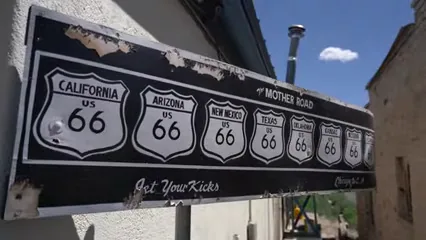
The Route 66 Centennial is a year-long national celebration of the 100th anniversary of Route 66, running throughout 2026. Route 66 was commissioned on November 11, 1926. The official national festivities began on April 30, 2026, marking 100 years since the road received its numerical designation.
3 confirmed 2026 Centennial events include:
- Route 66 Bike Week (April 21-27, 2026) – A motorcycle event at locations across Route 66 in California and Arizona, with photo submissions earning commemorative merchandise
- Route 66 Fun Run (May 1-3, 2026) – The oldest Route 66 celebration in the United States; participants from around the world meet in Seligman, Arizona, to drive 140 miles of Route 66 with events in every community along the way
- Tulsa Centennial Classic Car Parade (May 30, 2026) – Thousands of international visitors are expected; plans include a record-setting classic car parade
Communities across all 8 states are hosting festivals, car rallies, museum exhibitions, and cultural programming throughout 2026.
What Is the Best Time of Year to Tour America on Route 66?
The best time to tour Route 66 is late spring, from May through June. Temperatures across the Southwest are moderate. The Route 66 Fun Run in Seligman, Arizona, and the Tulsa Centennial events both fall in May 2026, making late May the highest-activity window of the centennial year.
3 travel windows by visitor type:
- Families – Late May through mid-June; schools are out and Southwest temperatures are below peak summer heat
- Car and motorcycle enthusiasts – Late May through June; car shows and rallies cluster during this period
- History and heritage travelers – Early to mid-November; communities hold formal commemorations tied to the November 11 official anniversary
Summer driving across New Mexico and Arizona reaches temperatures above 100 degrees Fahrenheit. Plan driving for early morning and evening hours on desert stretches in July and August.
How Much Does a Route 66 Road Trip Cost?
A full Route 66 road trip from Chicago to Santa Monica costs between $3,000 and $6,000 for a solo traveler over 14 days. This covers fuel, accommodation, food, and attraction entry fees.
Cost breakdown:
- Fuel – Approximately $400 to $600 based on a midsize vehicle averaging 30 mpg
- Accommodation – Route 66 motels average $60 to $120 per night; 14 nights totals $840 to $1,680
- Food – Budget $40 to $80 per day; diners serve full meals from $10 to $20
- Attractions – Most roadside stops are free or under $10; the Grand Canyon entrance fee is $35 per vehicle
Donald Reeves writes about Everglades City the way the place deserves to be written about: without the brochure language, without the manufactured wonder, and without pretending that a town of 400 people sitting at the edge of a swamp is something it is not.
He has spent considerable time in Collier County’s oldest settlement, arriving during stone crab season when the waterfront smells of brine and work, and returning in the off-season when the tourists are gone and the town goes quiet in the particular way that only genuinely remote places can. He has paddled the mangrove tunnels of the Ten Thousand Islands, eaten at places with no hours posted on the door, and spoken at length with fishing guides who navigate these waters by memory rather than chart.
His writing on Everglades City FL covers everything from tidal fishing conditions and kayak trails to lodging, local history, and the complex past that most Florida travel content carefully avoids.
He writes to give readers the honest version.